


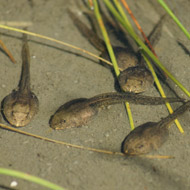
Frog is one of only 10 or 12 species that has evolved internal fertilisation
A new species of frog has been observed, for the first time, giving birth to tadpoles instead of laying eggs.
A member of the Asian group of fanged frogs, the new species was discovered a few decades ago by Indonesia researcher Djoko Iskander and was thought to give direct birth to tadpoles. However, the frog's mating and an actual birth had never been seen before.
In search of direct proof, UC Berkeley herpetologist Dr Jim McGuire travelled last summer to the rain forests of Indonesia's Sulawesi Island. It was here that he grabbed what he thought was a male frog and found himself juggling not only a frog, but also dozens of slippery, newborn tadpoles.
McGuire said: “Almost all frogs in the world – more than 6,000 species – have external fertilisation, where the male grips the female in amplexus and releases sperm as the eggs are released by the female - but there are lots of weird modifications to this standard mode of mating. This new frog is one of only 10 or 12 species that has evolved internal fertilisation, and of those, it is the only one that gives birth to tadpoles as opposed to froglets or laying fertilised eggs.”
Fanged frogs – so-called because of two fang-like projections from the lower jaw that are used in fighting – may have evolved into as many as 25 species on Sulawesi. However, this particular species, named Limnonectes larvaepartus, is only the fourth to be formally described.
Limnonectes larvaepartus prefers to give birth to tadpoles in small pools or seeps located away from streams, possibly to avoid the heftier fanged frogs hanging out around the stream. There is some evidence the males may also guard the tadpoles.
A Novel Reproductive Mode in Frogs: A New Species of Fanged Frog with Internal Fertilization and Birth of Tadpoles is published in
Plos One.
Image (C) Bohringer Friedrich


 Companies marketing medicines for small pets exempt from authorisation must submit their annual return to the Veterinary Medicines Directorate (VMD) by 30 November 2026.



