


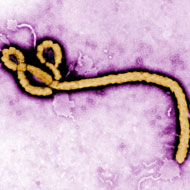
Education needed to reduce consumption of bats, researchers say
Scientists may have identified the bat species responsible for the current Ebola epidemic in West Africa.
A team of researchers visited the small village of Meliandou, Guinea, where the first human case of Ebola was confirmed in a two-year-old boy earlier this year.
Led by Fabian Leendertz from the Robert Koch Institute in Berlin, an international research team first studied wildlife populations in south-eastern Guinea.
Past outbreaks have caused populations to fall by up to 90 per cent. However, the team found no wildlife carcasses and did not report any recent declines in wildlife densities.
Researchers then visited Meliandou to investigate how the two-year-old boy may have come into contact with the virus.
Both children and adults hunt bats in Meliandou, as is the case in many parts of Africa, but children are more likely to hunt small, insectivorous bats. Researchers believe certain special features of this village could have caused the Ebola virus to transmit to humans.
The team discovered a large, burnt tree about 50 metres from the first patient's home and close to a path walked by women travelling to their washing place at a small river. The children reported that they had frequently played in and around the hollow tree before it burnt down in March this year.
Researchers were able to identify the species of bat residing in this tree by deep-sequencing ash samples and DNA in the soil. The species, Mops condylurus, has previously been noted as a possible reservoir for Ebola in central Africa. It has also been shown to survive infection and carry antibodies against Ebola viruses in the wild.
The Mops condylurus species is no longer found in Meliandou. Other fruit and insect-eating bats have since been analysed for Ebola infection but no virus could be found in these species.
Researchers say further studies are needed to understand the role of bats in Ebola virus transmission, to prevent future outbreaks.
Writing in the EMBO Molecular Medicine, the authors of the research paper stress that attempts to cull or evict bat colonies is often unsuccessful in reducing disease transmission - and in some cases even produces the opposite effect.
They are calling for education initiatives to inform the public about the risks posed by bats, recommending minimised contact with the animals and advising against their consumption.
Image (c) CDC Global/CC BY 2.0


 Companies marketing medicines for small pets exempt from authorisation must submit their annual return to the Veterinary Medicines Directorate (VMD) by 30 November 2026.



