


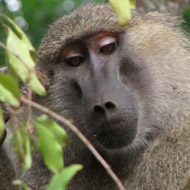
Cumulative culture previously thought to be unique to humans
A study by the University of Edinburgh has revealed that baboons may share the human ability to build on the work of others.
The phenomenon, known as cumulative culture, sees people make gradual improvements in knowledge over time to reach their goals - for example eradicating disease or sending rockets into space. It was previously thought to be unique to humans.
Researchers from the University of Edinburgh and CNRS Aix Marseille University devised a computer test where baboons had to try and remember grid patterns.
The baboons tried to replicate the patterns by pressing buttons on the screen - allowing the scientists to recreate the kind of cultural exchange of knowledge and skills that take place in humans. The patterns that one baboon produced, whether or not they were correct, became the patterns the next baboon in a chain had to memorise and reproduce.
The research team discovered that when the patterns are transmitted between baboons they changed to become easier to memorise and pass on.
In the same way that humans can perfect technologies, baboons were able to make gradual improvements to the patterns provided by others.
Prof Simon Kirby, from the University of Edinburgh’s School of Philosophy, Psychology and Language Sciences, said: “For a long time, researchers thought that cumulative culture was uniquely human. However, the evolution we see in our experiment mirrors human cumulative culture, providing an entirely new way of studying our species-defining trait.”
Dr Nicolas Claidière, from CNRS Aix Marseille University, added: “Baboons do not have complex culture in the wild, but appear to be capable of much more in our experimental set-up. Understanding why this is gets us closer to uncovering the crucial differences between humans and our primate relatives.”
The study is published in Proceedings of the Royal Society B.
Image (C) Gordon E. Robertson


 Companies marketing medicines for small pets exempt from authorisation must submit their annual return to the Veterinary Medicines Directorate (VMD) by 30 November 2026.



