


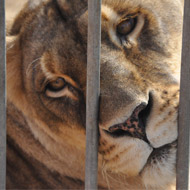
Elsa was facing a lifetime of misery behind bars
A lioness, who shares her name with the iconic lioness in the classic film 'Born Free', has been rescued from a ramshackle circus in Sardinia, the international wildlife charity The Born Free Foundation and Italian animal welfare organisation LAV have announced.
Believed to be around six years old, Elsa is in relatively good health despite the terrible conditions that she was living in. She is currently being relocated from Circus Martin, to a spacious temporary sanctuary in Tuscany, where she will stay until she can be permanently re-homed at Born Free's Big Cat Rescue Centre in South Africa.
Born Free's Daniel Turner, senior programmes manager for Zoo Check, said: "When I walked up to the barren enclosure, which was essentially just a circle of iron bars within a concrete car park, I was struck by the inadequacy of the dismal conditions this lioness was living in. When told that she was called Elsa - 'like in the film Born Free' - I quite literally had a shiver down my spine, especially as this year marks 30 years since the Foundation was established."
Born Free's founder, actress and conservationist, Virginia McKenna OBE said: "When I heard about this lioness victim called Elsa, for a moment my world rocked. I was suffused with bitter-sweet memories. Fifty years ago my beloved husband Bill and I had flown to Kenya to make the film 'Born Free', the true story of Elsa the lioness's journey to freedom which inspired a generation and changed our lives forever."
"It was back in 1984, that Bill and I began Zoo Check with our son will. The charity evolved into the Born Free Foundation, with the iconic 'Elsa' as its symbol, and so in the year of our 30th anniversary, what could be more poignant, more momentous, than rescuing this new Elsa from her life of misery and suffering? Giving her the proper home she deserves."
Elsa cannot be returned to the wild as she would not be able to survive on her own, but will remain in Tuscany for up to a year, pending the ongoing court case, before she is ready to make the long journey 'home' to Africa.
Once she has arrived at the Born Free Foundation's rescue centre near Port Elizabeth, she will enjoy a spacious enclose, surrounded by the sights and sounds of wild Africa.
The Born Free Foundation has set up an urgent appeal for Elsa. To make a donation, please visit www.bornfree.org.uk.
Image (C) Born Free Foundation


 Companies marketing medicines for small pets exempt from authorisation must submit their annual return to the Veterinary Medicines Directorate (VMD) by 30 November 2026.



