


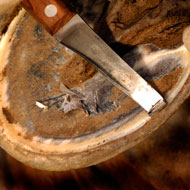
Vet and farrier communities urged to devise new trimming methods
New research by the University of Nottingham has revealed that the daily trimming of fingernails and toenails to make them more aesthetically pleasing, could potentially lead to serious nail conditions. Experts from the university's School of Veterinary Medicine and Science say that this research will improve understanding of disease in the hooves of horses and farm animals.
The researchers devised equations to identify the physical laws that control nail growth, and used them to discover the causes of some of the most common nail problems such as spoon-shaped nails, ingrown toes nails and pincer nails.
According to the study, regular poor trimming can tip the fine balance of nails, causing residual stress to occur across the entire nail. This residual stress can promote a change in shape of curvature of the nail over time which, in turn, can lead to serious nail conditions.
Dr Cyril Rauch, a physicist and applied mathematician who led the research, said: “Similar equations can be determined for conditions of the hoof and claw and applied to farm animals such as sheep, cattle, or horses and ponies. At a time when securing food across the world is important, a better understanding of the physics of hoof/claw has never been so essential to maintain the health of livestock and to sustain agriculture and food production.”
The research team focused specifically on ingrown toe nails and devised an equation which showed that when the balance between growth stress and adhesive stress is broken - for example, if a nail grows too quickly or slowly - a residual stress across the entire nail can occur, causing it to change shape over time.
Although this residual stress can occur in any fingernail or toenail; the stress is greater for nails that are larger in size and have a flatter edge. This explains why ingrown toe nails occur mostly in the big toe.
The equations also revealed that bad trimming of the nails can amplify the residual stress.
Dr Rauch feels that this research can be applied to farm animals and conditions associated with their hooves, which can be life threatening.
He said: “I believe that physics can make a difference by promoting a new type of evidence-based veterinary medicine and help the veterinary and farrier communities by devising trimming methods to alleviate pain and potentially remove the cause of serious conditions.”
The study, 'Physics of nail conditions: Why do ingrown nails always happen in their big toes' was published on Friday, October 17.


 Companies marketing medicines for small pets exempt from authorisation must submit their annual return to the Veterinary Medicines Directorate (VMD) by 30 November 2026.



