


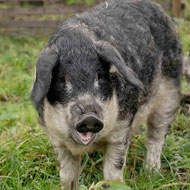
Conservation charity employs a herd of pigs for habitat creation
A herd of rare breed pigs have been tasked with creating a perfect habitat for endangered species in Dorset.
For the first time, the Royal Society for the Protection of Birds (RSPB) has recruited six Mangalitsa pigs to restore its Arne nature reserve to natural heathland through grazing.
It is hoped the site will then become an ideal home for species such as the Dartford warbler, nightjar, smooth snake, sand lizard and stonechats.
"It is an experimental project that we hope will produce fantastic results for nature at our Arne reserve," said Mark Singleton, RSPB Dorset reserves operations manager.
Last year, the RSPB's State of Nature report found that 60 per cent of UK species have declined over the past five decades. Mr Singleton said the rare breed pig project is "one of many that the RSPB is carrying out to tackle this problem and try to reverse these declines."
In its current state, the land at Arne is covered in pine needles and bracken, up to six inches deep in places.
Ordinarily the charity says it would use diggers and other machines to carry out the work, but the pigs are a more environmentally friendly option.
Mangalitsas are the only pig species in England to grow distinctive hairy fleeces similar to sheep. As they get stuck into the six-month project, the rare breed pigs will be joined by six Berkshire pigs.
The pigs are not alone in helping the charity with its conservation projects. Konik ponies, for example, help to manage habitats and create a mosaic of different vegetation types at RSPB Minsmere.
"There are many benefits to conservation grazing," said David Burton, senior advisor at Natural England. "Grazing animals helped shape many of our semi-natural habitats, which developed rich and diverse wildlife communities."
Image © Nienetwiler, Wikipedia CC BY-SA 3.0


 Companies marketing medicines for small pets exempt from authorisation must submit their annual return to the Veterinary Medicines Directorate (VMD) by 30 November 2026.



