


New insights into Serengeti migration
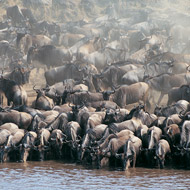
Evidence suggests there are about 80,000 wildebeest hunted illegally every year for the bushmeat trade
An estimated 1.3 million wildebeest and 250,000 zebra are making their annual migration across the Serengeti-Mara, with six of the animals helping in a unique tracking programme that is shedding light on how animals make decisions during the journey.
The migration, widely regarded as one of the most spectacular sights in the natural world, sees the two animals migrate together but the programme, led by Dr Grant Hopcraft of the University of Glasgow’s Boyd Orr Centre for Population and Ecosystem Health, has shown they move for very different reasons. Wildebeest are constantly looking for fresh grazing, whereas zebra balance their need to get access to good food against the relative risk of being killed by a predator. However, the results also show that both species are driven, above all else, by the need to avoid the threat of humans and human development.
The six animals involved in the study are wearing high-tech GPS collars that are equipped withmobile phone technology and this data, along with information from more than 30 others, collected over 10 years, has given an insight into the impact made by human activities.
The findings come at a time when the Tanzanian Government has been considering a national highway through the Serengeti to create a trade route from Dar es Salaam and other Indian Ocean ports to Lake Victoria, offering access to countries such as Uganda, Kenya, Burundi and Rwanda. If built, the road is likely to carry as many as 3,000 vehicles every day.
Dr Hopcraft says; “A road would have catastrophic effects on how these animals migrate. It would separate their dry season refuge from their wet season calving grounds. All 1.3 million wildebeest and 250,000 zebra would have to cross that road in order to access the Mara River which is the only source of water during the dry season."
Another threat to wildebeest and zebra is poaching. Evidence suggests there are about 80,000 wildebeest hunted illegally every year for the bushmeat trade.
“When these animals encounter areas of high poaching, both species attempt to exit the area as soon as possible by moving a long way and in straight lines, regardless of the food. It appears as though these animals can detect risky areas and respond accordingly, which means if we want to protect migrations we need to focus on managing humans and not the animals,” says Dr Hopcraft.
For more information see www.gla.ac.uk/news/headline_350044_en.html


 Companies marketing medicines for small pets exempt from authorisation must submit their annual return to the Veterinary Medicines Directorate (VMD) by 30 November 2026.



