


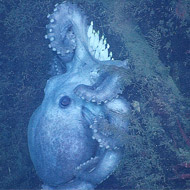
Deep-sea octopus broods her eggs for over four years
A deep-sea octopus has been observed brooding its eggs for four and a half years, longer than any other known animal.
The octopus was discovered in 2007 by a group of researchers at the Monterey Bay Aquarium Research Institute (MBARI). During a routine dive at a research site in Monterey Canyon, researchers found the octopus clinging to a rocky ledge, about 1,400 meters below the surface of the sea.
Over the next four and a half years, the researchers continued to dive at the same site. Each time they saw the same octopus, identifiable by her distinctive scars, in the same place. Over the years, her translucent eggs grew bigger and young octopuses could be seen developing inside. What is most astounding is that during this time, the researchers did not see the mother leave her eggs or eat anything.
The research team last saw the brooding octopus, a species known as Graneledone boreopacifica, in September 2011. When they returned one month later, the mother was gone and all that remained were the empty egg capsules. After counting the capsules, the researchers estimated that the mother had been brooding about 160 eggs.
MBARI say that such long brooding times present an evolutionary challenge, especially for octopus, which do not have a very long life-span. In a recent paper published in the Public Library of Science, the researchers say that, in addition to setting records for the longest brooding time of any animal, this species may be one of the longest-lived cephalopods - most shallow water octopuses and squids live just a couple of years.
They note: “The ultimate fate of a brooding female octopus is inevitably death, but in this first example from the deep sea, brooding also confers an extension of adult life that greatly exceeds most projections of cephalopod longevity.”
Image credit: 2007 MBARI


 Companies marketing medicines for small pets exempt from authorisation must submit their annual return to the Veterinary Medicines Directorate (VMD) by 30 November 2026.



