


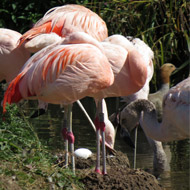
The flamingo egg is the first to be laid at WWT Washington in seven years.
A Chilean flamingo egg, the first in seven years, has been successfully laid at WWT Washington Wetland Centre in Tyne and Wear.
The egg was spotted in a nest on Monday (July 28). The centre say that the arrival marks the culmination of a pioneering two-year conservation breeding project, during which flamingo chicks were hand-reared from eggs, brought into the centre and integrated into the existing flock in a bid to encourage natural breeding.
The egg, laid by a 33 year-old female, has now been carefully swapped for a clay dummy as a safety precaution. Staff and volunteers at the centre now have an anxious wait to see if the egg is fertile.
Fertility can be determined at around 10 days by shining a torch through the shell to check if there's an embryo inside - a method known as 'candling'. If there is, then the egg will be incubated and cared for at the centre's specialist duckery, ensuring it has the best chance of survival. The egg will then be returned to the nest shortly before hatching.
WWT Washington's centre manager said: "Conservation is not black and white and whilst an egg isn't guaranteed to lead a successful hatch or survival, this is a fantastic and hard-worn achievement."
The unique hand-rearing project began in September 2012 and the first five Chilean flamingo chicks were introduced to the adult flock in May 2013. Later that year, extra staff and volunteers were trained up to help raise and care for a further 24 chicks. They moved into the adult enclosure in April bringing the total number of flamingos at the centre to 66.
WWT Washington's captive animal manager, Owen Joiner, explained: “By adding a further 24 chicks this April, we hoped to finally stimulate the adults into laying eggs, while at the same time increase the flock size and add young birds that would hopefully breed themselves in a few years’ time.
“With the arrival of yesterday’s egg, it would seem that our efforts have paid off. We’re now waiting with cautious optimism to see if the egg is fertile and if any more will be laid.”
Image courtesy of Graham Clarkson, WWT


 Companies marketing medicines for small pets exempt from authorisation must submit their annual return to the Veterinary Medicines Directorate (VMD) by 30 November 2026.



