


Wildlife centre inundated with young owls
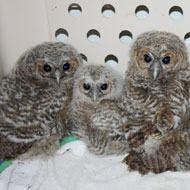
RSPCA West Hatch Wildlife Centre has its hands full with dozens of young tawny owl admissions over the last month.
The centre, near Taunton in Somerset, has admitted an equivalent of one nestling or fledgling owlet every day for the last four weeks, from locations across the south-west of England.
The young owls have been discovered by members of the public in various unfortunate situations - such as orphaned, grounded beside a barn, having had their nests disturbed by forestry workers, found beside power lines and caught by cats.
Paul Oaten is the wildlife centre supervisor at RSPCA West Hatch. He said: “We do not know why we have had so many in such a short space of time. It could be that the high winds we had a short while ago blew some down from the branches, or it might just be a coincidence. Tawny owls are one of the more common owls we have admitted.
“With 28 little tawny owl mouths to feed – as well as all our other animals, it is a busy and costly time for our centre”.
The RSPCA has advised members of the public not to interfere with young birds unless they are vulnerable or endangered. However well-meaning, human handling causes the birds to become stressed, and being fed an inappropriate diet can cause developmental problems.
The suggested action to take upon discovering a fledgling that appears to be abandoned or injured would be to watch them from a distance to see whether the parents come back to feed them, or if they make their way back to their nest themselves. If the young owl is obviously injured or in danger, it would be appropriate to take it straight to the RSPCA.
For further guidance about when and when not to help a bird, click here.
Image courtesy of the RSPCA.


 Companies marketing medicines for small pets exempt from authorisation must submit their annual return to the Veterinary Medicines Directorate (VMD) by 30 November 2026.



