


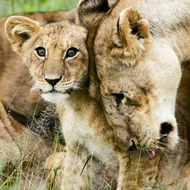
Project "saves" the lives of 75 lions a year by safeguarding 75,000 livestock
A project designed to save lions by ending conflict between them and Maasai people in Tanzania, is reaping rewards.
For years the Maasai people had lived in conflict with lions – lions would attack and kill their livestock and the Maasai people would hunt and kill lions, both in retaliation, and as a right of passage to becoming a Maasai warrior.
That had contributed to the decline of lions in the Maasai Steppe region of Tanzania.
But a charity project by the African People and Wildlife Fund (APW) seems to have brought an end to the cycle of conflict.
While the Maasai people had traditionally sought to protect their livestock by building enclosures made out of the branches of thorny acacia trees. But these quickly deteriorate and proved no match for predators.
The APW has been working with the Maasai people to create "living walls" of planted indigenous commiphora trees, interlinked with chain link fencing.
The trees continue to grow, adding density and height to the wall.
To date, around 350 of these living walls have been made on the Maasai Steppe.
"These Living Walls are protecting 75,000 livestock nightly, improving the livelihoods of more than 7,000 Maasai people, and saving the lives of approximately 75 lions annually," said a spokesman for APW.
"Additionally, our Living Walls have significantly reduced habitat clearing and given time back to Maasai women."
The method of protecting livestock is now being adopted in other parts of Africa including Kenya and Mozambique.
At the same time AWP is also working with school children to raise awareness of the importance of lion conservation.
Image by David Dennis


 Companies marketing medicines for small pets exempt from authorisation must submit their annual return to the Veterinary Medicines Directorate (VMD) by 30 November 2026.



