


First cattle scab case confirmed in Scotland
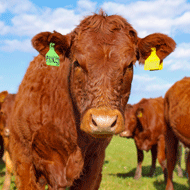
Farmers have been warned to be vigilant and report suspected cases to their vet.
A warning has been issued to farmers after cattle scab has been confirmed in Scotland for the first time since the early 1980s.
The disease was found on a Scottish Borders farm in a calf recently imported from outside of Great Britain, with its suckler cow mother.
Testing was carried out at SAC Consulting's veterinary investigation centre in St Boswells.
Cases of the disease have been seen in Wales, south west England and Yorkshire. It is present in mainland Europe and Ireland.
Also known as psoroptic mange, it is caused by mites that pierce the skin to feed, causing severe irritation. The signs are similar to sheep scab.
Helen Carty from SAC Consulting Veterinary Services said the disease has "severe welfare implications" if it is not quickly identified and treated.
It causes severe dermatitis with scab formation along shoulders, back and tail head, but can also spread over the lower body, hind legs and tail. Secondary infections are common, leading to bleeding and crusting.
"It has the potential to become established in Scotland because of the movement of animals and the difficulties of treatment," Helen warned. "I would urge farmers to remain vigilant for any signs of cattle scab and to notify their vet of any suspect cases."
Concerned farmers have been warned to seek advice their vet. Laboratory analysis is vital to differentiate the disease from other external parasites. However, treatment is "problematic", according to SAC.
Helen explains: "Successful treatment is not straightforward. All the animals in the group, and any other in-contact animals, regardless of whether they are showing clinical signs, must be treated.
"Experience in Wales suggests the mites are resistant to commonly used products and none are licensed for use in milking dairy cows."
The National Farmers Union (NFU) Scotland is repeating its call for cattle scab to become a notifiable disease in Scotland.
Nigel Miller, president of NFU Scotland, said: "It is imperative that infected cattle are locked-down for transport if this parasite is not to become an endemic problem in Scotland.
"If it does become endemic it will affect the status of Scottish cattle and undo the hard work of the industry to establish a reputation for quality within Scottish cattle."
Scientists from Moredun Research Institute are working to adapt the diagnostic blood test for sheep scab, to detect mange in cattle.
Using funding from the Scottish Government, SAC is offering free testing of skin scrapings. In addition, vets are encouraged to take blood samples from suspected cases, which should be sent to the local SAC Consulting Veterinary Services Disease Surveillance Centre.


 Companies marketing medicines for small pets exempt from authorisation must submit their annual return to the Veterinary Medicines Directorate (VMD) by 30 November 2026.



