


Former MP tells of "heartbreaking" plight of Cairo's horses
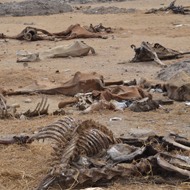
In the shadows of the pyramids lies a makeshift graveyard for horses, animals left to starve to death amid the country's political unrest.
Hundreds of horses that would normally pull tourist carriages around Cairo, have been left to scavenge for food.
The Society for the Protection of Animals Abroad, and former MP Ann Widdecombe have visited the Giza Pyramids area in Cairo to see the plight of the horses there.
"It has been truly shocking and heartbreaking to see the plight of horses here, especially the area that’s become a makeshift horse graveyard," said Ann.
Tourist numbers to Cairo Egypt have collapsed in the past year. Nearly 50 per cent fewer tourists visited the country in the last three months of 2013, compared to the same period in 2012.
The reason has been put down to the ongoing political unrest in the country.
But that has meant that Cairo's carriage drivers have been left with hardly any income, leaving them without the money to feed their animals.
“Tourists will stay away from Egypt until political stability returns and in the meantime horses will suffer," said Ann.
SPANA is running an emergency programme to provide basic rations to feed 200 horses a day.
Jeremy Hulme, SPANA’s chief executive, said: “Thousands of people rely on the tourism industry for their income in Egypt and can’t afford to feed their families at the moment, never mind their animals.
"This is why our emergency feeding programme is absolutely vital to help keep animals alive until tourism returns.
“Tragically, many horses and camels in the area have already died; they are truly the forgotten victims of this crisis.”
The feeding programme is being run in association with SPANA’s partner organisation ESAF (the Egyptian Society of Animal Friends).
For more information visit www.spana.org/egypt or call 020 7831 3999.
Image courtesy of SPANA


 Companies marketing medicines for small pets exempt from authorisation must submit their annual return to the Veterinary Medicines Directorate (VMD) by 30 November 2026.



