


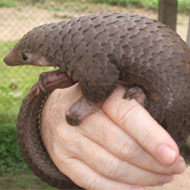
Scales are sold for use in Chinese medicine
Pangolins are globally threatened animals whose scales are used in traditional Chinese medicine.
Now an official report has found that they are being illegally traded on a "shocking" scale.
Zhao-Min Zhou, from the Public Security Bureau for Forests in China's Yunnan province, worked with researchers from the University of Oxford.
Their findings are published in the journal Frontiers in Ecology and the Environment.
They uncovered records of 2.59 tonnes of scales being seized since 2010, representing around 4,870 pangolins. As well as this 259 intact pangolins, 220 of which were still alive, were also seized.
The report also highlights that last November, Beijing customs intercepted five parcels of pangolin scales weighing 70kg each. They subsequently discovered a further tonne of scales had been shipped in this way since April, the equivalent of 1,660 individual animals.
According to the report, pangolin scales are currently worth £360 per kilo, twice the amount they traded for in 2008.
There are eight species of pangolin – four in Africa and four in Asia.Chinese and Sunda pangolins are listed as endangered by the International Union for the Conservation of Nature. Their Indian and Philippine cousins, alongside Africa's giant and white -bellied pangolins, are considered near threatened.
Prof David Macdonald, director of the University of Oxford's Wildlife Conservation Research Unit (WildC) called the number of pangolins traded "Shocking."
Pangolins give birth to one offspring per year. Conservationists warn that current declines are unsustainable.
Image (c)


 Companies marketing medicines for small pets exempt from authorisation must submit their annual return to the Veterinary Medicines Directorate (VMD) by 30 November 2026.



