


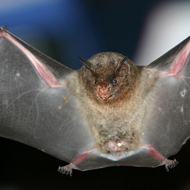
Bats less likely to feed and spread seeds in lit area, study finds
A study has found that the effects of artificial light on bats could have a major impact on tropical rainforests.
A research team in Costa Rica studied fruit eating bats to see if they avoided lit areas when searching for food.
"Under naturally dark conditions, bats produce a copious seed rain even in deforested habitats," said the research paper by Daniel Lewanzik and Christian Voight, published in the Journal of Applied Ecology.
They said that large areas of the rainforests are being turned into agricultural land, and are then being abandoned because the soil is not fertile enough to make it profitable.
The rate of reforestation is slow. Bats can effectively aid this by dropping seeds in flight.
But the encroachment of people near to the rainforests, and with it artificial light, is having an impact on bat flight patterns.
Researchers carried out an experiment using Sowell's short-tailed bats (C.sowelli), a flight cage and a street lamp.
They found bats were twice as likely to fly into dark areas, than an area that was dimly lit.
Similar findings were obtained in recordings of bat behaviour in the field.
"Our study provides first evidence that frugivorous bats are repelled by artificial light at night, indicating that light pollution interferes with valuable ecosystem services provided by nocturnal seed dispersers.
"In particular, experiments with captive C.sowelli highlighted that bats performed more exploitative flights and harvested fruits more often in a dark than in an illuminated environment.
"This has major implications for ecosystem functioning when tropical habitats are increasingly exposed to artificial light," the authors said.
They concluded "the detrimental effects of light pollution are likely to increase and may have a great impact on biodiversity, particularly in the tropics where artificial light follows human encroachment in natural habitats at unprecedented rates."
Image by Diego Lizcano


 Companies marketing medicines for small pets exempt from authorisation must submit their annual return to the Veterinary Medicines Directorate (VMD) by 30 November 2026.



