


Scientists predict impacts of invasive species
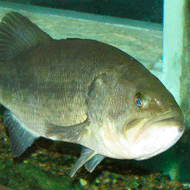
Largemouth bass
Scientists may now be able to predict the ecological impact of invasive species by studying features of their behaviour.
A research team from Queen's University Belfast collaborated with South African institutions to study the behaviour of some of the world's most invasive species, such as the large-mouth bass that generally devastates invertebrate and other fish communities wherever it is introduced.
Prior to their research, study of the characteristics of invasive species has proved inconclusive.
The only reliable method of predicting the impact of an invasive species has been its previous impacts elsewhere - no use for invaders with no known history.
Professor Jaimie Dick from Queen's explained the findings: "We presented the invasive fish, and local native fish of the same type, with tadpole prey at increasing densities. The invader fish consumed the prey at more than three times the rate of the native fish.
"The prey populations are simply not able to tolerate this increased mortality, and often go extinct soon after the invaders arrive. The data show that the invaders are predictable in their impacts by relatively simple derivation of their functional response curves as compared to natives."
For their research, the team used an ecological theory known as "functional response curve", which relates the rate at which organisms consume resources to the density of that resource.
Prof Dick said: "We now have a method that allows us to understand the impacts of current invaders, but also to forecast the impacts of emerging and new invaders.
"We can also use the technique to predict how changing features of the environment, such as temperature, can increase or decrease the impacts of invaders. Our focus now is to examine if this technique works for a wide range of organisms.
"We are now testing the idea for other invasive fish, shrimps, wasps, and even plants, as they too can be measured as to their resource uptake rates, for example, with enriched nitrogen."
The research has been published in the Royal Society Journal "Biology Letters" and has been selected for F1000Prime, a group that identifies significant articles in biology and medical research publications.
View the research online here.


 Companies marketing medicines for small pets exempt from authorisation must submit their annual return to the Veterinary Medicines Directorate (VMD) by 30 November 2026.



