


Honeybee diseases spread to wild bees
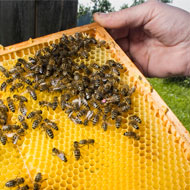
Scientists say disease management policies should consider threats to wild bees.
Common diseases in managed honeybee colonies have become widespread in wild bee populations, according to new research by Royal Holloway, University of London.
Scientists say the research, published in the journal Nature, offers crucial insights into ensuring honeybee management supports wild bees.
Dr Matthias Fürst from Royal Holloway's School of Biological Sciences explained: "Wild and managed bees are in decline at national and global scales.
"Given their central role in pollinating wildflowers and crops, it is essential that we understand what lies behind these declines. Our results suggest that emerging diseases, spread from managed bees, may be an important cause of wild bee decline."
After analysing certain diseases commonly found in honeybees, scientists discovered that deformed wing virus (DWV) and the fungal parasite Nosema ceranae can also infect bumblebees.
Honeybees and bumblebees were collected from 26 different UK sites and screened for the diseases, both of which have serious impacts on honeybee health. Scientists found both diseases to be widespread in UK bumblebees and honeybees.
According to Dr Fürst, the study showed DWV is replicating inside bumblebees, demonstrating that they are not just carriers of the disease.
When the research team looked at how the diseases spread, they found honeybees and bumblebees from the same sites shared genetic strains of DWV. In addition, higher background levels of both diseases were found in honeybees and bumblebee infection was predicted by patterns of honeybee infection.
According to experts, this suggests the parasites are spreading from managed honeybees to wild bumblebees.
Professor Mark Brown, also from Royal Holloway, explained: "We have known for a long time that parasites are behind declines in honeybees. What our data show is that these same pathogens are circulating widely across our wild and managed pollinators.
"Infected honeybees can leave traces of disease, like a fungal spore or virus particle, on the flowers that they visit and these may then infect wild bees."
Following the research, scientists are calling for changes to be made in the way honeybee diseases are managed to protect wild bee populations. Professor Brown added: "National societies and agencies, both in the UK and globally, currently manage so-called honeybee diseases on the basis that they are a threat only to honeybees.
"While they are doing great work, our research shows that this premise is not true, and that the picture is much more complex. Policies to manage these diseases need to take into account threats to wild pollinators and be designed to reduce the impact of these diseases not just on managed honeybees, but on our wild bumblebees too."


 Companies marketing medicines for small pets exempt from authorisation must submit their annual return to the Veterinary Medicines Directorate (VMD) by 30 November 2026.



