


Genetic chip to boost salmon quality
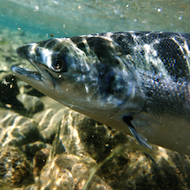
Farmers can pinpoint genes linked to desirable traits and select the best fish for breeding.
Salmon breeders will be able to improve the quality of their stock and its resistance to disease thanks to the development of new technology.
Breeders can select the best fish for breeding with the help of a chip loaded with thousands of pieces of DNA, each holding a fragment of the salmon's genetic code. Scientists say it carries twenty times more genetic information than existing tools.
The chip works by detecting variations in the genetic code of each fish. Breeders can use these variations to identify genes that are associated with desirable traits, such as resistance to certain diseases.
By taking a small sample of fin tissue, breeders can carry out the test themselves.
The technology has been developed by scientists from the Roslin Institute and Edinburgh Genomics, in partnership with the Universities of Stirling and Glasgow.
Dr Ross Houston from the Roslin Institute commented: "Selective breeding programmes have been used to improve salmon stocks since the 1970s.
"This new technology will allow the best breeding fish to be selected more efficiently and accurately, particularly those with characteristics that are difficult to measure such as resistance to disease."
Similar technology has already been used to transform breeding programmes for livestock including cattle and pigs.
Salmon fishing is said to bring approximately £500 million to the UK economy every year and is a healthy, high quality food source.
Dr Alan Tinch, director of genetics at Landcatch Natural Selection, who collaborated with scientists in developing the chip, said: "This development takes selective breeding programmes to a whole new level.
"It is an extension to the selective breeding of salmon allowing more accurate identification of the best fish to create healthier and more robust offspring."
Research has been published in the journal BMC Genomics and the chip is expected to be available to breeders and farmers from March 2014.


 Companies marketing medicines for small pets exempt from authorisation must submit their annual return to the Veterinary Medicines Directorate (VMD) by 30 November 2026.



