


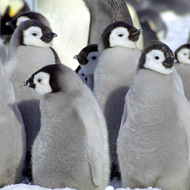
Scientists say behaviour "Totally unexpected"
Antarctic emperor penguins have scaled ice shelves up to 30m high as they adapt to environmental changes, scientists have said.
Penguin colonies traditionally breed on thin sea ice.
But satellite observations showed that in the years when this sea ice was late forming, the penguins moved to much thicker floating ice shelves.
Peter Fretwell from the British Antarctic Survey (BAS), lead author of a team of scientists, said: “These charismatic birds tend to breed on the sea ice because it gives them relatively easy access to waters where they hunt for food.
"Satellite observations captured of one colony in 2008, 2009 and 2010 show that the concentration of annual sea ice was dense enough to sustain a colony.
"But this was not the case in 2011 and 2012 when the sea ice did not form until a month after the breeding season began.
"During those years the birds moved up onto the neighbouring floating ice shelf to raise their young.
“What’s particularly surprising is that climbing up the sides of a floating ice shelf – which at this site can be up to 30 metres high – is a very difficult manoeuvre for emperor penguins. Whilst they are very agile swimmers they have often been thought of as clumsy out of the water.”
The findings by the BAS, together with the Australian Antarctic Division and the Scripps Institution of Oceanography at UC San Diego in California, were reported in
online journal, PLOS ONE.
Emperor penguins have been designated as 'near threatened' on the International Union for Conservation of Nature (IUCN) red list. This is due to the penguins' reliance on sea ice for breeding grounds, alongside changing patterns to when that sea ice is formed.
But the satellite images suggests the species may be adapting their behaviour to survive.
Barbara Wienecke of the Australian Antarctic Division said: “These new findings are an important step forward in helping us understand what the future may hold for these animals, however, we cannot assume that this behaviour is widespread in other penguin populations.
"The ability of these four colonies to relocate to a different environment – from sea ice to ice shelf - in order to cope with local circumstances, was totally unexpected.
"We have yet to discover whether or not other species may also be adapting to changing environmental conditions.”
Image by Guillaume Dargaud


 Companies marketing medicines for small pets exempt from authorisation must submit their annual return to the Veterinary Medicines Directorate (VMD) by 30 November 2026.



