


MBE for international farrier
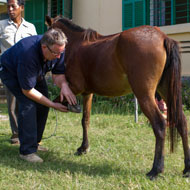
A farrier working for World Horse Welfare, has been awarded the MBE in the New Year's Honours list.
International farrier Tom Burch was awarded the MBE for services to horse welfare in the UK and overseas.
World Horse Welfare's director of international Liam Maguire, said: “We are delighted that Tom’s efforts to help horses and their owners have been Royally recognised.
"World Horse Welfare knows from experience that in the UK or overseas, all horses need good farriers, and Tom is one of the very best.
"We are proud that he is training students on our projects in Africa, Central America and Cambodia.”
Mr Burch apprenticed as a farrier in Kent before joining the Metropolitan Police in 1979. He retired as senior farrier in 2009.
After he retired from the Met, he was asked to join the UK’s National Farrier Training Agency as a Field Officer (now Farrier Placement Officers) to help make sure UK apprentices’ training was on track.
“I do it because I want to put something back," said Mr Burch. "When I finished my apprenticeship I promised myself that if the opportunity arose I would do whatever I could to help apprentices and promote good farriery.
"I am especially grateful to the Metropolitan Police for allowing me the time to work internationally with World Horse Welfare which has made me a better teacher and hopefully improved the welfare of those horses, and the people who rely on them for their livelihoods.
"From a personal perspective, it’s interesting to see how people do things in other countries and there is a lot of job satisfaction. The students really appreciate the skills you are sharing with them.”
Mr Burch has trained farriers overseas with World Horse Welfare since 1998. He has trained more than 150 farriery students in countries such as Kenya, South Africa, Romania, Honduras, Nicaragua, El Salvador and Cambodia.
He was also instrumental in setting up the charity’s farriery training programmes overseas which offered the most promising students extra training to help teach other farriers in the country, spreading these skills more widely.
World Horse Welfare has run international programmes to help working horses and their owners for almost 30 years. These programmes have expanded from farriery and saddlery, to include nutrition and basic veterinary care.
There are an estimated 100 million work horses in the World, and these programmes also help the owners who rely on their horses for their livelihood.
“Working horses and donkeys still fuel the economies of many countries around the world by transporting people and goods where cars and trucks are not practical or affordable," said Mr Maguire.
"However, many of the people who own and use them don’t really know how to look after them, so we try to bridge that gap in knowledge.
"This helps both the horse and the owner, and can make all the difference as to whether a family can eat that day.
"World Horse Welfare wants to make sure that human development organisations understand the role of working horses and their importance, and this will be the theme of our upcoming 7th International Colloquium on Working Equids in London this July.”
Image courtsey of World Horse Welfare.


 Companies marketing medicines for small pets exempt from authorisation must submit their annual return to the Veterinary Medicines Directorate (VMD) by 30 November 2026.



